Initiatives don't fail in execution.
They fail in design.
They fail in design.
Most initiative were never designed to cross the gap.
We design the bridge that connects your highest ambitions to successful results.
Applied across national laboratories, global manufacturers, technology firms, and complex government programs.












What Changes When You Work With Us
How We Help Organizations Design for Success
About Terry Schmidt
About Terry Schmidt
Helping leaders design initiatives that succeed under execution.
Across global enterprises, national research laboratories, and the executive classrooms of UCLA Extension’s Technical Management Program, he observed the same pattern: capable teams working hard on initiatives whose underlying design was never made explicit.
That insight led him to modernize the Logical Framework into a practical discipline known as Strategic Project Design — an approach that clarifies the outcomes initiatives must deliver, the assumptions they depend on, and the logic connecting effort to results.
He has trained more than 25,000 professionals in this approach.
Execution problems usually start as design problems. Strategic Project Design fixes them upstream.
![About [Terry Schmidt]{.text-primary}](/images/TerryHandsome.jpeg)
![About [Terry Schmidt]{.text-primary}](/images/TerryHandsomeHalf.jpeg)
Strategic Project Design
Strategic Project Design
The Discipline Between Strategy and Results
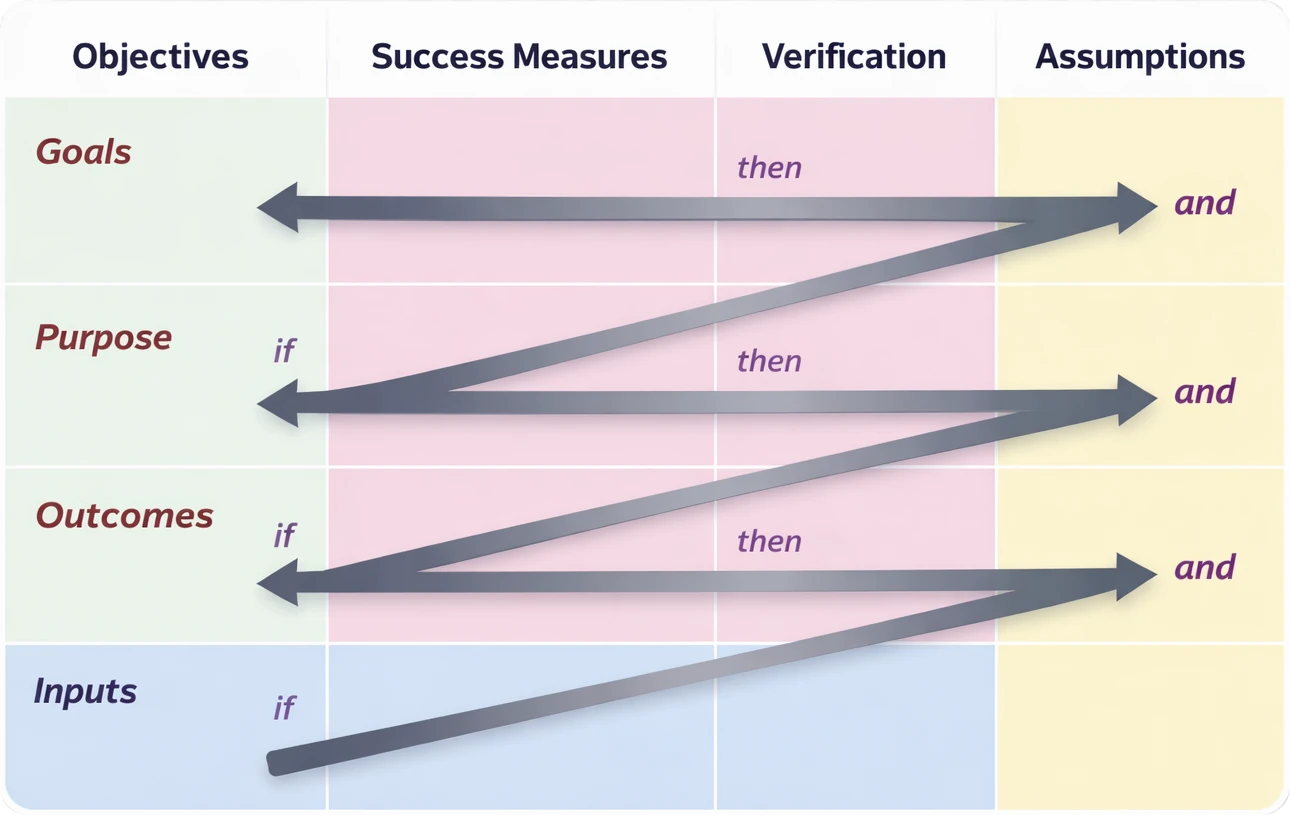
Strategic Project Design is an upstream discipline — one that operates before planning begins, clarifying the design logic that makes planning coherent and execution reliable. Most organizations move quickly from strategy to planning. When the underlying design is unclear, plans multiply while alignment erodes. Strategic Project Design resolves this by making the architecture of an initiative explicit: the outcomes it must produce, the assumptions it depends on, and the causal chain connecting effort to results. At the center of the discipline is the Logical Framework (LogFrame) — a structured design tool that organizes an initiative across four levels and links them through explicit measures, verification, and assumptions. It provides a clear cause-and-effect hypothesis that leaders can test before execution begins, surfacing gaps and hidden risks while they’re still inexpensive to fix.
What Our Clients Say
What Our Clients Say

Antonio Nieto-Rodriguez
former Global Chairman of the Project Management Institute

Philippe Goetschel
Director, Microsoft

James Whalen
Vice President, DirecTV, Inc.

Don Levy
SVP, Sony Pictures Digital

Adam Gilmore
Space Station Mechanisms Lead, NASA

Laurie Triplett
Environmental Physicist, Los Alamos National Laboratory